Testking Workday-Pro-Integrations Learning Materials | Workday-Pro-Integrations Exam Details
Wiki Article
DOWNLOAD the newest ValidDumps Workday-Pro-Integrations copyright from Cloud Storage for free: https://drive.google.com/open?id=1KC8hsF--lSsHFI3-_kUY3fXXUdCXUOD3
Passing the Workday-Pro-Integrations certification can prove that you are very competent and excellent and you can also master useful knowledge and skill through passing the test. Purchasing our Workday-Pro-Integrations guide torrent can help you copyright and it costs little time and energy. The Workday-Pro-Integrations exam questions have simplified the sophisticated notions. The software boosts varied self-learning and self-assessment functions to check the learning results. The software of our Workday-Pro-Integrations Test Torrent provides the statistics report function and help the students find the weak links and deal with them.
As a matter of fact, long-time study isn’t a necessity, but learning with high quality and high efficient is the key method to assist you to succeed. We provide several sets of Workday-Pro-Integrations test torrent with complicated knowledge simplified and with the study content easy to master, thus limiting your precious time but gaining more important knowledge. Our Workday Pro Integrations Certification Exam guide torrent is equipped with time-keeping and simulation test functions, it’s of great use to set up a time keeper to help adjust the speed and stay alert to improve efficiency. Our expert team has designed a high efficient training process that you only need 20-30 hours to prepare the exam with our Workday-Pro-Integrations Certification Training. With an overall 20-30 hours’ training plan, you can also make a small to-do list to remind yourself of how much time you plan to spend in a day with Workday-Pro-Integrations test torrent.
>> Testking Workday-Pro-Integrations Learning Materials <<
Testking Workday-Pro-Integrations Learning Materials & Free PDF Quiz 2026 Workday Workday Pro Integrations Certification Exam Realistic Exam Details
Workday-Pro-Integrations exam prep has an extensive coverage of test subjects, a large volume of test questions, and an online update program. Workday-Pro-Integrations test guide is not only the passbooks for students passing all kinds of professional examinations, but also the professional tools for students to review examinations. In the past few years, Workday-Pro-Integrations question torrent has received the trust of a large number of students and also helped a large number of students passed the exam smoothly.
Workday Pro Integrations Certification Exam Sample Questions (Q10-Q15):
NEW QUESTION # 10
Refer to the following XML to answer the question below.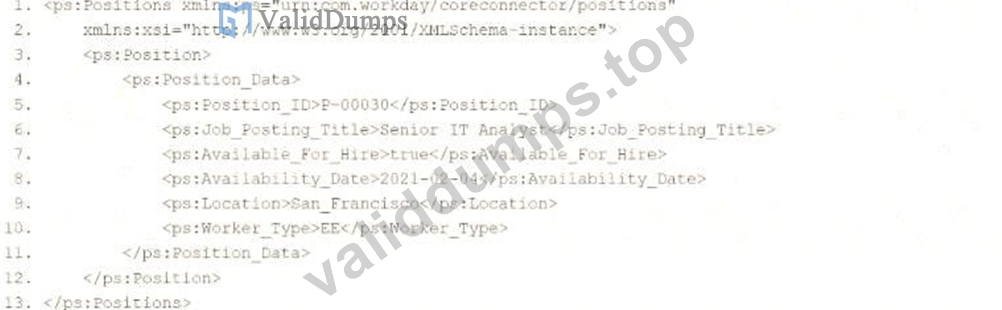
You need the integration file to format the ps:PositionJD field to 10 characters and report any truncated values as an error.
How will you start your template match on ps:Position to use Document Transformation (DT) to do the transformation using ETV with your truncation validation?
- A.
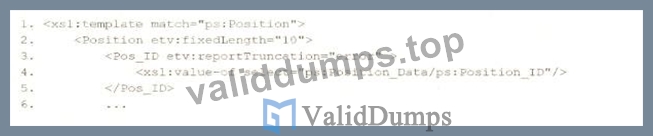
- B.

- C.
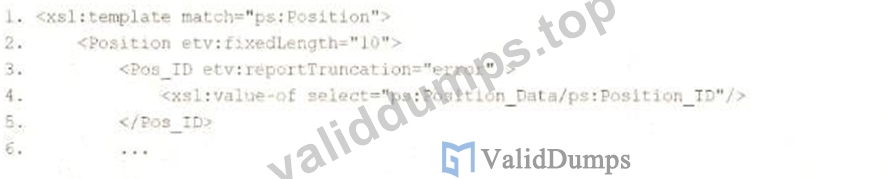
- D.

Answer: D
Explanation:
In Workday integrations, Document Transformation (DT) using XSLT is employed to transform XML data, such as the output from a Core Connector or EIB, into a specific format for third-party systems. In this scenario, you need to transform the ps:Position_ID field within the ps:Position element to a fixed length of 10 characters and report any truncation as an error using Workday's Extension for Transformation and Validation (ETV) attributes. The template must match the ps:Position element and apply the specified formatting and validation rules.
Here's why option D is correct:
* Template Matching: The <xsl:template match="ps:Position"> correctly targets the ps:Position element in the XML, as shown in the provided snippet, ensuring the transformation applies to the appropriate node.
* ETV Attributes:
* etv:fixedLength="10" specifies that the Pos_ID field should be formatted to a fixed length of 10 characters. This ensures the output is truncated or padded (if needed) to meet the length requirement.
* etv:reportTruncation="error" instructs the transformation to raise an error if the ps:Position_ID value exceeds 10 characters and cannot be truncated without data loss, aligning with the requirement to report truncated values as errors.
* XPath Selection: The <xsl:value-of select="ps:Position_Data/ps:Position_ID"/> correctly extracts the ps:Position_ID value from the ps:Position_Data child element, as shown in the XML structure (<ps:
Position_ID>P-00030</ps:Position_ID>).
* Output Structure: The <Position><Pos_ID>...</Pos_ID></Position> structure ensures the transformed data is wrapped in meaningful tags for the target system, maintaining consistency with Workday integration practices.
Why not the other options?
* A.
xml
WrapCopy
<xsl:template match="ps:Position">
<Position>
<Pos_ID etv:fixedLength="10">
<xsl:value-of select="ps:Position_Data/ps:Position_ID"/>
</Pos_ID>
</Position>
</xsl:template>
This option includes etv:fixedLength="10" but omits etv:reportTruncation="error". Without the truncation reporting, it does not meet the requirement to report truncated values as errors, making it incorrect.
* B.
xml
WrapCopy
<xsl:template match="ps:Position">
<Position etv:fixedLength="10">
<Pos_ID etv:reportTruncation="error">
<xsl:value-of select="ps:Position_Data/ps:Position_ID"/>
</Pos_ID>
</Position>
</xsl:template>
This applies etv:fixedLength="10" to the Position element instead of Pos_ID, and etv:reportTruncation=" error" to Pos_ID. However, ETV attributes like fixedLength and reportTruncation should be applied to the specific field being formatted (Pos_ID), not the parent element (Position). This misplacement makes it incorrect.
* C.
xml
WrapCopy
<xsl:template match="ps:Position">
<Position etv:fixedLength="10">
<Pos_ID etv:reportTruncation="error">
<xsl:value-of select="ps:Position_Data/ps:Position_ID"/>
</Pos_ID>
</Position>
</xsl:template>
Similar to option B, this applies etv:fixedLength="10" to Position and etv:reportTruncation="error" to Pos_ID, which is incorrect for the same reason: ETV attributes must be applied to the specific field (Pos_ID) requiring formatting and validation, not the parent element.
To implement this in XSLT for a Workday integration:
* Use the template from option D to match ps:Position, apply etv:fixedLength="10" and etv:
reportTruncation="error" to the Pos_ID element, and extract the ps:Position_ID value using the correct XPath. This ensures the ps:Position_ID (e.g., "P-00030") is formatted to 10 characters and reports any truncation as an error, meeting the integration file requirements.
Workday Pro Integrations Study Guide: Section on "Document Transformation (DT) and ETV" - Details the use of ETV attributes like fixedLength and reportTruncation for formatting and validating data in XSLT transformations.
Workday Core Connector and EIB Guide: Chapter on "XML Transformations" - Explains how to use XSLT templates to transform position data, including ETV attributes for length and truncation validation.
Workday Integration System Fundamentals: Section on "ETV in Integrations" - Covers the application of ETV attributes to specific fields in XML for integration outputs, ensuring compliance with formatting and error-reporting requirements.
NEW QUESTION # 11
What is the purpose of the <xsl:template> element?
- A. Grant access to the XSLT language.
- B. Generate an output file name.
- C. Determine the output file type.
- D. Provide rules to apply to a specified node.
Answer: D
Explanation:
The <xsl:template> element is a fundamental component of XSLT (Extensible Stylesheet Language Transformations), which is widely used in Workday integrations, particularly within document transformation systems such as those configured via the Enterprise Interface Builder (EIB) or Document Transformation Connectors. Its primary purpose is to define rules or instructions that dictate how specific nodes in an XML source document should be processed and transformed into the desired output format.
Here's a detailed explanation of why this is the correct answer:
* In XSLT, the <xsl:template> element is used to create reusable transformation rules. It typically includes a match attribute, which specifies the XML node or pattern (e.g., an element, attribute, or root node) to which the template applies. For example, <xsl:template match="Employee"> would target all
<Employee> elements in the source XML.
* Inside the <xsl:template> element, you define the logic-such as extracting data, restructuring it, or applying conditions-that determines how the matched node is transformed into the output. This makes it a core mechanism for controlling the transformation process in Workday integrations.
* In the context of Workday, where XSLT is often used to reformat XML data into formats like CSV, JSON, or custom XML for external systems, <xsl:template> provides the structure for specifying how data from Workday's XML output (e.g., payroll or HR data) is mapped and transformed.
Let's evaluate why the other options are incorrect:
* A. Determine the output file type: The <xsl:template> element does not control the output file type (e.
g., XML, text, HTML). This is determined by the <xsl:output> element in the XSLT stylesheet, which defines the format of the resulting file independently of individual templates.
* B. Grant access to the XSLT language: This option is nonsensical in the context of XSLT. The <xsl:
template> element is part of the XSLT language itself and does not "grant access" to it; rather, it is a functional building block used within an XSLT stylesheet.
* D. Generate an output file name: The <xsl:template> element has no role in naming the output file. In Workday, the output file name is typically configured within the integration system settings (e.g., via the EIB or connector configuration) and is not influenced by the XSLT transformation logic.
An example of <xsl:template> in action might look like this in a Workday transformation:
<xsl:template match="wd:Worker">
<Employee>
<Name><xsl:value-of select="wd:Worker_Name"/></Name>
</Employee>
</xsl:template>
Here, the template matches the Worker node in Workday's XML schema and transforms it into a simpler
<Employee> structure with a Name element, demonstrating its role in providing rules for node transformation.
Workday Pro Integrations Study Guide: "Configure Integration System - TRANSFORMATION" section, which explains XSLT usage in Workday and highlights <xsl:template> as the mechanism for defining transformation rules.
Workday Documentation: "XSLT Transformations in Workday" under the Document Transformation Connector, noting <xsl:template> as critical for node-specific processing.
W3C XSLT 1.0 Specification (adopted by Workday): Section 5.3, "Defining Template Rules," which confirms that <xsl:template> provides rules for applying transformations to specified nodes.
Workday Community: Examples of XSLT in integration scenarios, consistently using <xsl:template> for transformation logic.
NEW QUESTION # 12
Refer to the following scenario to answer the question below.
You need to configure a Core Connector: Candidate Outbound integration for your vendor. The connector requires the data initialization service (DIS).
The vendor needs a value on the output file which contains the average number of jobs a candidate applied to.
This value is not delivered by Workday so you have identified that you will need to build a calculated field to generate this value.
What steps do you follow to output the calculated field?
- A. Configure integration field attributes to output the calculation.
- B. Configure integration field overrides to output the calculation.
- C. Configure a custom field override service to output the calculation.
- D. Configure integration attributes to output the calculation.
Answer: B
Explanation:
The scenario involves a Core Connector: Candidate Outbound integration requiring a calculated field for the average number of jobs a candidate applied to, which isn't a delivered Workday field. The task is to output this calculated field in the integration file. Core Connectors in Workday use predefined templates but allow customization through various configuration options. Let's evaluate the steps:
* Context:
* Core Connector: Candidate Outbound uses the Data Initialization Service (DIS) to extract candidate data.
* A calculated field must be created (e.g., averaging the "Number of Job Applications" field across a candidate's records).
* This value needs to be included in the output file sent to the vendor.
* Integration Field Overrides:In Core Connectors, calculated fields are typically incorporated into the output by definingintegration field overrides. This feature allows you to map a calculated field to a specific field in the connector's output structure, overriding the default delivered value (or adding a new field). The calculated field is built separately (e.g., in Report Writer or Calculated Fields) and then referenced in the integration configuration.
* Option Analysis:
* A. Configure a custom field override service to output the calculation: Incorrect. There's no
"custom field override service" in Workday Core Connectors. This might confuse with integration field overrides, but it's not a distinct service.
* B. Configure integration attributes to output the calculation: Incorrect. Integration attributes define metadata or settings for the integration (e.g., file name, delivery method), not specific field mappings for output data.
* C. Configure integration field attributes to output the calculation: Incorrect. "Integration field attributes" isn't a precise Workday term for this purpose; it may confuse with field-level settings, but field overrides are the correct mechanism.
* D. Configure integration field overrides to output the calculation: Correct. This is the standard method in Core Connectors to include calculated fields in the output file by overriding or adding to the delivered field structure.
* Implementation:
* Create a calculated field (e.g., "Average Job Applications") using functions like Arithmetic Calculation to average job application counts.
* In the Core Connector configuration, navigate to theIntegration Field Overridessection.
* Define a new field or override an existing one, mapping it to the calculated field.
* Test the integration to ensure the calculated value appears in the output file.
References from Workday Pro Integrations Study Guide:
* Core Connectors & Document Transformation: Section on "Configuring Integration Field Overrides" explains mapping calculated fields to output files.
* Integration System Fundamentals: Details how Core Connectors extend delivered functionality with custom calculations.
NEW QUESTION # 13
Refer to the scenario. You are implementing a Core Connector: Worker integration to send employee data to a third-party active employee directory. The external vendor requires the following:
The Employee's Active Directory User Principal Name.
A mapping from Worker Type values to external worker type codes.
A specific filename format that includes a timestamp and sequence number.
You also need to ensure the document transformation occurs before the file is delivered to the endpoint. You must include an Employee's Active Directory User Principal Name (generated by a Calculated Field).
How do you ensure this field is pulled into the output?
- A. Configure an integration map.
- B. Configure an integration field override.
- C. Configure an integration field attribute.
- D. Configure an integration attribute.
Answer: B
Explanation:
To surface a Calculated Field in a Core Connector: Worker (CCW) outbound, you use an Integration Field Override to substitute the connector's default source with your calculated value. An integration map (Option A) is intended to translate or normalize code values (for example, mapping internal Worker Type codes to the vendor's codes), not to replace the source of a field. Integration attributes (Option D) and integration field attributes (Option C) manage connector behavior and attributes, but they do not replace a field's data source with a calculated field. Therefore, the correct method to "pull" a calculated field into the CCW output is an Integration Field Override (Option B).
Why the other elements in the scenario matter (and how they're handled) - with exact extracts from your materials:
Mapping Worker Type to external codes → Integration Maps (supports, but not the asked action):Your deployment guides call out maintaining and using Integration System Maps for code translations. This is exactly where you'd map "Worker Type" to the external system's codes, but it is not how you inject a calculated field into the payload.
"Maintenance of Integration System Maps"
"WORKDAY SETUP - NON STATIC MAPS" and "WORKDAY SETUP - STATIC MAPS" (table of contents for configuration of maps) Filename requires timestamp/sequence number → Sequence Generator (supports the scenario):Your Time Tracking/PECI deployment guide explicitly includes a Sequence Generator configuration that's used with certified connectors to build compliant, unique file names (often with timestamps and/or sequence numbers) before delivery.
"3.6 Sequence Generator" (configuration item for certified integrations used in file naming) Transformation before delivery → Standard integration flow (transform then deliver):The same deployment materials describe document/file delivery mechanics (for example, SFTP), which occur after the integration produces/transforms the document. This supports the scenario requirement that transformation happens prior to transmission.
"4. FILE DELIVERY SERVICE ... 4.4 SFTP Configuration" (document delivery occurs after the integration generates/transforms the output) Security posture for integrations (context):For outbound/system users and secure delivery, the Workday Authentication & Security guide documents integration-appropriate authentication (e.g., X.509) and general integration security steps - relevant background for productionizing CCW but not directly affecting how to bring a calculated field into the payload.
"X509 Recommended for web services users and integrations that use an integration system user account." Putting it all together for the scenario:
Use Integration Field Override to point the CCW field to your Calculated Field for UPN → (Correct answer: B).
Use Integration Maps to translate Worker Type to the vendor's codes (supports the mapping requirement).
Configure filename rules via Sequence Generator to include timestamp and sequence in the produced file name (supports the file-naming requirement).
Ensure the document transformation runs as part of the integration generation step and then deliver via SFTP (file delivery service).
Reference (Workday Pro: Integrations-aligned materials):
GPC_PECI_TimeTracking_DeploymentGuide_CloudPay.pdf - Sections "3.6 Sequence Generator" and "4. File Delivery Service" (delivery occurs after file generation/transform).
GPC_PECI_DeploymentGuide_CloudPay_2.9.pdf - Map configuration sections ("WORKDAY SETUP - NON STATIC MAPS", "WORKDAY SETUP - STATIC MAPS").
GPC_PECI_UserGuide_CloudPay_2.1.1.pdf - "Maintenance of Integration System Maps." Admin-Guide-Authentication-and-Security.pdf - Integration security notes, including X.509 recommendation for integrations.
NEW QUESTION # 14
Refer to the following XML to answer the question below.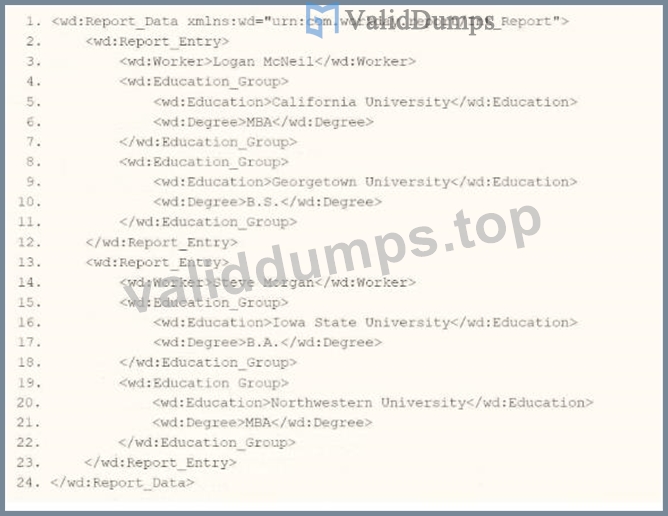
Within the template which matches on wd:Report_Entry, you would like to conditionally process the wd:Education_Group elements by using an <xsl:apply-templates> element. What XPath syntax would be used for the select to iterate over only the wd:Education_Group elements where the Degree is an MBA?
- A. wd:Education_Group[wd:Degree='MBA']
- B. wd:Report_Entry/wd:Education_Group[wd:Degree='MBA' 1:Degree='MBA']
- C. wd:Report_Entry/wd:Education_Group/ wd:Degree='MBA' 1:Degree='MBA'
- D. wd:Education_Group/wd:Degree='MBA'
Answer: A
Explanation:
In Workday integrations, XSLT is used to transform XML data, such as the output from a web service-enabled report or EIB, into a desired format for third-party systems. In this scenario, you need to write XSLT to process wd:Education_Group elements within a template matching wd:Report_Entry, using an <xsl:apply-templates> element to iterate only over wd:Education_Group elements where the wd:Degree is "MBA." The correct XPath syntax for the select attribute is critical to ensure accurate filtering.
Here's why option A is correct:
XPath Syntax In XPath, square brackets [ ] are used to specify predicates or conditions to filter elements. The condition wd:Degree='MBA' checks if the wd:Degree child element has the value "MBA." When applied to wd:Education_Group, the expression wd:Education_Group[wd:Degree='MBA'] selects only those wd:Education_Group elements that contain a wd:Degree child element with the value "MBA." Context in XSLT: Within an <xsl:apply-templates> element in a template matching wd:Report_Entry, the select attribute uses XPath to specify which nodes to process. This syntax ensures that the template only applies to wd:Education_Group elements where the degree is "MBA," aligning with the requirement to conditionally process only those specific education groups.
XML Structure Alignment: Based on the provided XML snippet, wd:Education_Group contains wd:Education and wd:Degree child elements (e.g., <wd:Degree>MBA</wd:Degree>). The XPath wd:Education_Group[wd:Degree='MBA'] correctly navigates to wd:Education_Group and filters based on the wd:Degree value, matching the structure and requirement.
Why not the other options?
B . wd:Education_Group/wd:Degree='MBA': This is not a valid XPath expression for a predicate. It attempts to navigate to wd:Degree as a child but does not use square brackets [ ] to create a filtering condition. This would be interpreted as selecting wd:Degree elements under wd:Education_Group, but it wouldn't filter based on the value "MBA" correctly within an <xsl:apply-templates> context.
C . wd:Report_Entry/wd:Education_Group/wd:Degree='MBA' 1:Degree='MBA': This is syntactically incorrect and unclear. It includes a malformed condition (1:Degree='MBA') and does not use proper XPath predicate syntax. It fails to filter wd:Education_Group elements based on wd:Degree='MBA' and is not valid for use in select.
D . wd:Report_Entry/wd:Education_Group[wd:Degree='MBA' 1:Degree='MBA']: This is also syntactically incorrect due to the inclusion of 1:Degree='MBA' within the predicate. The 1: prefix is not valid XPath syntax and introduces an error. The correct predicate should only be wd:Degree='MBA' to filter the wd:Education_Group elements.
To implement this in XSLT:
Within your template matching wd:Report_Entry, you would write an <xsl:apply-templates> element with the select attribute set to wd:Education_Group[wd:Degree='MBA']. This ensures that only wd:Education_Group elements with a wd:Degree value of "MBA" are processed by the corresponding templates, effectively filtering out other degrees (e.g., B.S., B.A.) in the transformation.
This approach ensures the XSLT transformation aligns with Workday's XML structure and integration requirements for processing education data in a report output.
:
Workday Pro Integrations Study Guide: Section on "XSLT Transformations for Workday Integrations" - Details the use of XPath in XSLT for filtering XML elements, including predicates for conditional processing based on child element values.
Workday EIB and Web Services Guide: Chapter on "XML and XSLT for Report Data" - Explains the structure of Workday XML (e.g., wd:Education_Group, wd:Degree) and how to use XPath to navigate and filter data.
Workday Reporting and Analytics Guide: Section on "Web Service-Enabled Reports" - Covers integrating report outputs with XSLT for transformations, including examples of filtering elements based on specific values like degree types.
NEW QUESTION # 15
......
ValidDumps offers accurate and reliable study materials to help you prepare for the Workday Workday-Pro-Integrations Exam. They have prepared the best Workday Workday-Pro-Integrations Exam Questions that provide authentic and reliable material. With ValidDumps, many candidates have succeeded in passing the Workday Workday-Pro-Integrations Exam.
Workday-Pro-Integrations Exam Details: https://www.validdumps.top/Workday-Pro-Integrations-exam-torrent.html
Workday Testking Workday-Pro-Integrations Learning Materials This is not only time-consuming and laborious, but also is likely to fail, If you face any hitch while using the Workday Workday-Pro-Integrations practice exam software of ValidDumps, contact our customer support, You will gradually be aware of the great importance of stimulating the actual Workday-Pro-Integrations exam after learning about our Workday-Pro-Integrations study tool, Our Workday-Pro-Integrations Exam Details - Workday Pro Integrations Certification Exam practice material has also keeps pace with the development.
They are made by top managers and affect the organization's business direction, Workday-Pro-Integrations In some cases, the evolution of technology is so dramatic that little remains of the foundational idea on which the technology is based.
2026 Workday Testking Workday-Pro-Integrations Learning Materials - Workday Pro Integrations Certification Exam Realistic Exam Details 100% Pass
This is not only time-consuming and laborious, but also is likely to fail, If you face any hitch while using the Workday Workday-Pro-Integrations Practice Exam software of ValidDumps, contact our customer support.
You will gradually be aware of the great importance of stimulating the actual Workday-Pro-Integrations exam after learning about our Workday-Pro-Integrations study tool, Our Workday Pro Integrations Certification Exam practice material has also keeps pace with the development.
We can say that our Workday-Pro-Integrations exam questions are the most suitable for examinee to copyright.
- Workday - Workday-Pro-Integrations - Workday Pro Integrations Certification Exam –Updated Testking Learning Materials ???? The page for free download of ▷ Workday-Pro-Integrations ◁ on ✔ www.prepawayexam.com ️✔️ will open immediately ????Exam Discount Workday-Pro-Integrations Voucher
- Actual Workday Workday-Pro-Integrations Exam Question For Quick Success ???? ➤ www.pdfvce.com ⮘ is best website to obtain ▷ Workday-Pro-Integrations ◁ for free download ⏏Workday-Pro-Integrations Mock Exam
- Valid Workday-Pro-Integrations Exam Format ↕ Free Workday-Pro-Integrations Exam Questions ???? Workday-Pro-Integrations New Study Guide ☎ Easily obtain free download of ▶ Workday-Pro-Integrations ◀ by searching on ➤ www.prep4away.com ⮘ ????Workday-Pro-Integrations Exams Collection
- Workday-Pro-Integrations Mock Exam ???? Exam Discount Workday-Pro-Integrations Voucher ⭐ Free Workday-Pro-Integrations Exam Questions ???? Go to website 「 www.pdfvce.com 」 open and search for ➽ Workday-Pro-Integrations ???? to download for free ????Workday-Pro-Integrations Exam Cram
- Certification Workday-Pro-Integrations Exam Infor ???? Best Workday-Pro-Integrations Vce ⛰ Workday-Pro-Integrations Exam Cram ???? Search for ▛ Workday-Pro-Integrations ▟ and download exam materials for free through ( www.testkingpass.com ) ????Workday-Pro-Integrations Test Cram Review
- Exam Discount Workday-Pro-Integrations Voucher ???? Workday-Pro-Integrations Exam Cram ???? Test Workday-Pro-Integrations Sample Questions ???? Search for 【 Workday-Pro-Integrations 】 and obtain a free download on ➤ www.pdfvce.com ⮘ ????Workday-Pro-Integrations Mock Exam
- Actual Workday Workday-Pro-Integrations Exam Question For Quick Success ↘ Open 【 www.examcollectionpass.com 】 enter [ Workday-Pro-Integrations ] and obtain a free download ????Test Workday-Pro-Integrations Sample Questions
- Workday-Pro-Integrations Test Cram Review ???? Reliable Workday-Pro-Integrations Test Review ???? Workday-Pro-Integrations Exam Cram ???? Easily obtain free download of [ Workday-Pro-Integrations ] by searching on ➠ www.pdfvce.com ???? ????Exam Workday-Pro-Integrations Exercise
- Workday-Pro-Integrations Practice Exam ???? Workday-Pro-Integrations Test Cram Review ???? Latest Workday-Pro-Integrations Exam Preparation ???? Go to website ( www.prep4away.com ) open and search for ⮆ Workday-Pro-Integrations ⮄ to download for free ????Workday-Pro-Integrations Test Cram Review
- Reliable Workday-Pro-Integrations Test Review ???? Exam Workday-Pro-Integrations Dump ⭐ Related Workday-Pro-Integrations Exams ???? Copy URL ▛ www.pdfvce.com ▟ open and search for 《 Workday-Pro-Integrations 》 to download for free ????Related Workday-Pro-Integrations Exams
- Workday-Pro-Integrations study guide - Workday-Pro-Integrations torrent vce - Workday-Pro-Integrations valid dumps ???? Easily obtain free download of ( Workday-Pro-Integrations ) by searching on [ www.dumpsquestion.com ] ????Certification Workday-Pro-Integrations Exam Infor
- louisesrma671718.fliplife-wiki.com, myportal.utt.edu.tt, myportal.utt.edu.tt, myportal.utt.edu.tt, myportal.utt.edu.tt, myportal.utt.edu.tt, myportal.utt.edu.tt, myportal.utt.edu.tt, myportal.utt.edu.tt, myportal.utt.edu.tt, myportal.utt.edu.tt, sahilhlyf900610.wikihearsay.com, alphabookmarking.com, bookmarkspecial.com, bookmarksea.com, dillanuanj017551.blogchaat.com, keybookmarks.com, alphabookmarking.com, jonasdblh124698.ktwiki.com, Disposable vapes
P.S. Free & New Workday-Pro-Integrations dumps are available on Google Drive shared by ValidDumps: https://drive.google.com/open?id=1KC8hsF--lSsHFI3-_kUY3fXXUdCXUOD3
Report this wiki page